
Programmes! Get yer programmes!
...or don't.

Until the start of this season, I was Editor of Boundary Bulletin, the official matchday programme of Oldham Athletic Football Club. In many ways it was a dream job – not for the money, which was a joke, but because of the sense of using my amazing professional skills (top-class words monkey) for the edification of Oldham Athletic.
Boundary Bulletin, together with the football writing in the Oldham Chronicle and the Manchester Evening News, was pretty much my early years reading. By early years, I mean up to age 16. For me and perhaps me alone, editing Boundary Bulletin was the prestige gig, the homecoming, a huge blue and white and tangerine feather in the cap.
I resigned, but really they left me more than the other way around. There were three problems: the tension between my ambition for the programme and their lack of it; their relentless focus on club sensibilities rather than my focus on providing a quality product for the people who buy the programme; and their infuriating and repeated disrespect and lack of professionalism, which was way short of what anyone would expect.
Before I go into those things, I want to say that I wish Oldham Athletic all the best. I’m looking forward once again to watching as a fan. It’s been too long (not quite a year) since I’ve been just another middle-aged terrace idiot. Part of me hopes that someone in the club reads this and learns something from it. It’s more likely that, if they do get to the end, they’ll be somewhat prickly and prissy about it. I have strong evidence that people to the far north of the club media hierarchy cannot read properly. There’s no shame in that. It’s a dying art.
The graveyard of ambition
The writing on the wall was there from the moment the club more or less conceded that the matchday programme is dying. They reckon there’s no going back because people got out of the habit of buying programmes during covid, and because the information programmes contain is already on the internet.
These are lazy, pathetic excuses, based on the fallacy of the all-powerful external force. Politicians use it when they say that their failure to get elected is down to the bias of the media, or attributable to the stupidity of the electorate. They look anywhere but themselves for the explanation.
Sales went up when I was editor (giving me the chance to open my resignation letter with this banger: “Thank you for giving me the opportunity to increase your sales by loads and loads and loads, which I grabbed with both hands”).
The club’s ambition was to stabilise at sales of about 10% of the expected gate. I wanted – and reckoned we could have got – sales back up around the 20% mark.
My ambition – a simple and modest one for the editor of a print publication – was to increase sales by improving the content and making the thing easier to buy. Let’s start with the content before we go down the rabbit hole of sales.
It’s the content, stupid
The major way in which you can improve sales is to improve editorial quality. People buy the thing for the content. With Boundary Bulletin, you can improve the content and word will get around. The goodwill towards the club is at an historical high. Build it and they will come.
The editions leading up to my first as editor were so, so improvable. In all truth, I couldn’t miss. There were some proper basics. We were printing tangerine text on blue background, white on blue, blue on tangerine. Tiny typeface, shiny paper. You couldn’t read any of it.
I’m very much a traditionalist in the sense that I want people to be able to read the text I commission, edit and publish so, early in the piece, I decided that anything more than 50 words would be a dark, dark navy blue on white, the way Gutenburg did the FC Strasbourg programme back in the day but without the Nazi typeface. The club had settled on 7pt text and I had to stick with it, but 8pt is the minimum I’d want. No point telling a longer story if you can’t read anything after “Once upon a time…”
Rate it don’t hate it
I drew up a framework of six criteria by which to judge the merits or otherwise of our editorial content. Here is a piece of the framework:

My idea is that we could all – me, people in the club, select punters – use this framework to evaluate our editorial content, perhaps adding criteria as we go along. The questions that flow from it give us the chance to talk about improvements. These could be small scale: how can we up the sponsor value of “Sitting down with…”? Is the manager page really worth a 5 for “Exclusivity” if it’s a transcript of an interview with the manager we’ve already put out on the website?
Suggestions could be more radical: “Should we ditch the pitch squares page for something worthwhile?”
As you can see from the example above, it’s also a great way to evaluate proposals for content. I’ve not included some of the poorer ones. You can’t have a semi-naked lady on page three anymore dad.
The most important function of the framework was for me: can I do anything to the words to make the thing better than it otherwise would be? That’s what I’m looking to do when crunching the copy. Make it better, in those ways, if possible.
Here’s what you could have won
My proposals for new and improved content didn’t actually come from me. That would have been silly. I am inclined towards the provocative and the niche, the whacky literary fringe, and I am fully aware of this. Instead, I let the readers do the talking.
From the new year onwards, I placed in the programme a small and sometimes bigger plea to readers to give me their views. This was possibly the first time any editor of the matchday programme had shown that level of respect to the readers. I put the same thing out to the many brilliant volunteer and in-house contributors. From their submissions, a number of solid proposals emerged. None of them was any different to what you could read in other programmes, and were in that sense conservative. Interviews with former players (the more recent the better); a puzzles and quiz page; more in-depth coverage of the opposition; a greater personality-driven focus on the Oldham Athletic Women and the Academy, which is very much up the club’s street at the moment because of its direction of travel in further education; general football op-eds, which gets its own little section down below.
Some of the existing content needed a boost. For example, we had a small, thin sidebar for the mascots. These days, people pay for mascot packages, and if anyone is going to be keeping that particular edition of Boundary Bulletin, it’s the parents. In last season’s programme, each mascot had a football card, which I believe is connected to a computer game. I was furnished with these by the in-house graphic designer. I could read them if I wanted to – by zooming in to 300% – but no one with the physical programme (the only edition) could. Their keepsake was our afterthought. As far as I know, that will persist this season, although I do hope the club can accommodate a page for the mascots (there are six or seven per game) and a little Q&A-based profile that the parents can produce when the kids grow up and bring someone round for the first time.
I’d Op-ed for something better
In the round, I wanted more football editorial content. That’s what people pay their £3 for. I made one more suggestion (again from the pool of submitted ideas): a one-page op-ed on general football issues. What’s the lowdown on the new regulator? Why are flares such an abomination? Policing, terrace culture, social media and football…and so on.
I knew that the club would not allow this. I sent two perfectly reasonable examples, the first of which was a wait-and-see plea for the regulator. The thrust of it was that the redistribution of money is the key to its success, not deciding before the fact whether Jason Whittingham should own Morecambe. With a fairer distribution of money, even a bellend like him could make a go of running a club. I did not mention specific clubs or people in my proposed op-ed.
The response from the club was exactly what I expected: it won’t sit well with the board. What? The board don’t want to read what one fan writes about an issue as a point of discussion for other fans? Is that it?
Another thing was said in the very last discussion I had on the subject: the regulator came in the other day, so we shouldn’t really be talking about it.
Yes, we should be talking about it. The regulator has put itself in a position of enormous power over the game, the leagues and the constituent clubs. Clubs will have their relationships with the regulator – the usual unfathomable, dark football politics. But the idea that programme readers need not know anything about the regulator is bananas.
As I said in my final meeting with the club, when Joe Royle was manager of Oldham Athletic, he once used his programme notes to call for the restoration of capital punishment to deter football hooliganism. What’s wrong with people expressing opinions that are well developed and well written?
In the end, the programme wasn’t censored only by an unwillingness to say things that the board might not like to read. Now we’re bound by the emotional fragility of the regulator. In this instance, the people who buy (or who might buy) the programme come a distant third in the reckoning. The lucky buggers. Sometimes they’re way further down the list of people for whom the programme is produced.
The information gets lost
This is just one thing that strikes me as a perfect example of editorial failure - it’s not a failure to see so much as a failure to look.
One of the things you will see in this season’s Boundary Bulletin is an unreadable table of fixtures and results. Total waste of space and time. You know the one. Lots of clubs produce it in one format or another. You have the games on one axis and match information on the other. The tables worked very well in the days of 15-man squads or maximum 20 players per season.
Here’s a more recent one from the Crystal Palace programme, which was sold to me as an exemplar of the form.
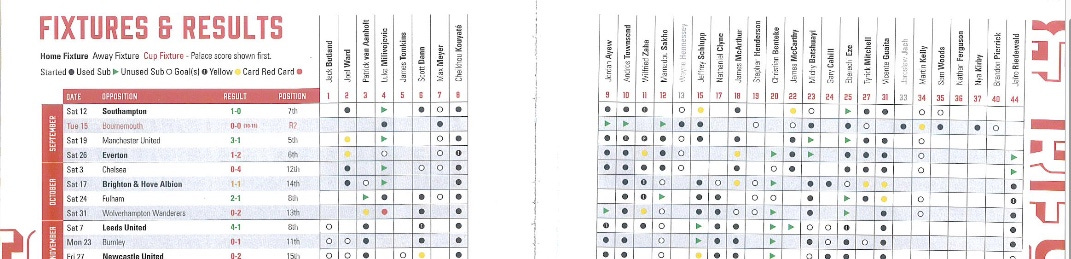
It’s crap. It doesn’t work. Even if it did work for them, it wouldn’t for us. The reason is simple and yet fundamental: you can’t retrieve information from it. It is a spreadsheet with zero functionality, no filters. It’s data landfill.
Palace have their players on the horizontal axis, which is the usual way. (Note that the names are upended so you have to turn the programme 90° to read them, which is only the start of the ballache.) At that point in the season, Palace had used ~31 players. The more players you use, the more you have to flatten the typeface. Oldham will use 40+ players this season, as we did last season. Once you squeeze all of them and their data in, you can’t read the names or find the data. What do programme editors have against their readers? Why are they making them work so hard?
That format for fixtures and results is dead, dead, dead, and also emblematic of the difference between what I saw as important and what the club saw as important. Their thinking was: everyone does it that way, so why shouldn’t we?
My answer is a gestalt shift, but not a difficult one like duck/rabbit. The thought process goes like this: you move from “it’s crap but everyone’s doing it” to “it’s crap and everyone is doing it”.
There you go. Everyone is doing it wrong. It’s one of those things. People just haven’t realised or admitted to themselves that it is outdated – perhaps because that would mean someone has to do some work to make it better – so they pretend it’s okay to print something that no one can read. Of course, the programme editor can read it perfectly well – by zooming in to 400%. The punters can’t read it because the typeface is 4pt and we don’t have an online version. It's not okay to print things from which no one can retrieve information.
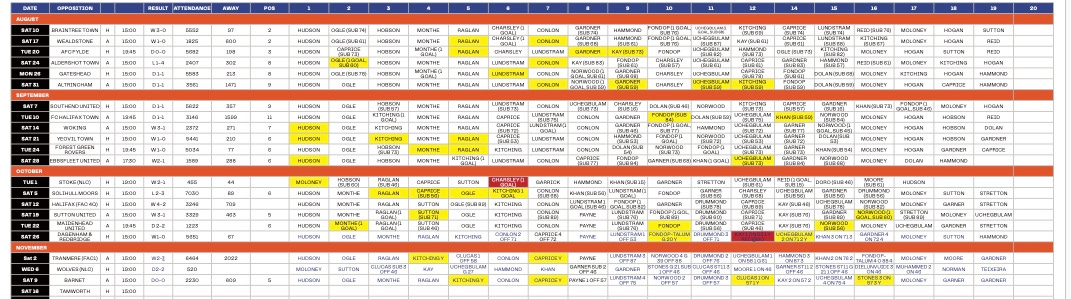
This is the crap I inherited. The format means there isn’t space for all the data in these boxes. Let me try that again: the boxes from the column labelled 1 to the end and all the way down have overset text – text that you, dear reader, cannot see.
My solution, which I arrived at in consultation with a couple of people who’d written in to say that the page was unreadable, was fairly simple, but also effective. You have three lines for one game, going across one page.
The one-page bit is important. The Palace table and the one we used go across two pages – they’re a spread, which adds another difficulty: what happens in the middle where the staples are? Palace have left it blank, meaning it’s impossible on paper to follow a line across from fixture to unused sub. As I recall, ours was just printed right over the middle. When you’ve already committed to printing something no one can read, why not add another barrier? Who’s cares if it’s unreadable for two reasons rather than just one?

Of course, once you start a new season, you just fill in the boxes after the match. I got us up to 6pt text, which is still unsatisfactory, but with loads of white space so your eyes can breathe as you count how many goals Josh Kay scored.

You may have noticed that the final effort above does not contain disciplinary information. That is because we didn’t have that information after the first games as pictured above. It was retrievable and recordable piecemeal, but by the time I got it, the data had lapsed and disappeared, so we just didn’t have it when I painstakingly reproduced it line by line in the redesign. If they use my design next season, you’ll know who’s got yellows and reds. If they do what everyone else does, you won’t. The disciplinary information (among other details) is in the overset text. Unbelievable.
Such a tragic waste of time. Two volunteers did all the proofreading. As it stands, that’s one load of three hours and two loads of two hours going down the tubes, plus my unpaid design work.
The Business Prevention Department
Those editorial differences were compounded by the unwillingness or inability of the club to address certain anomalies in the selling of the programme. My ambition in this respect was to make the thing easier to buy so that our excellent volunteer and in-house contributors - and the sponsors - got the exposure they deserved. There is no point driving editorial quality when no one reads the thing. You might as well start a Substack.
“Make it easier to buy?” I hear you say. “You just hand over your money or card and someone pulls a programme out of their hi-viz bag no? How can you make that easier?”
The cashless society
The summer before last, the club made a big noise about going cashless. You could use cash in the club shop and ticket office, which are outside the ground, but you can’t use cash to pay on the gate or to buy anything once you’ve gone through the turnstile. It wasn’t to everyone’s taste, but it has worked out okay and was properly telegraphed by the club so there were only a few unhappy surprises.
The thing that got left behind in all this was the match programme. You can pay for that using cash in the ground. In fact, you can have a programme only if you pay in cash. You can shove your Visa where the sun don’t shine, Sir. Your Amex does nothing for me, Madam.
Let me recap…mainly because I can still barely believe it.
You are told, “Don’t bother bringing cash to the ground.”
You poke your phone towards the programme seller:
“You cannot have a programme if you do not have cash.”
I’m sure every football club in the world has an active and influential Business Prevention Department, but the Oldham Athletic BPD has come up with only a handful of better ruses over the last 130 years.
The only way you can pay cash for the programme for a given home game is to wait till the next home game, when they will be stocked in the club shop.
Wrong rewards
There’s another important madness to the sales interface. One factor that influences how many programmes we print is whether or not we have people to do the selling on a given matchday. These are generally young, paper-round-age people and, through no fault of theirs, the system of remuneration is nuts.
The final home game last season was the National League play-off eliminator against FC Halifax Town. I was making one of my rare visits to Boundary Park and showed willing by selling the programme to the Halifax fans as they came into the Chaddy End. I gave it the big ’un – what else was I gonna do?
“Get yer programmes! Plenty of pictures for them what can’t read.”
“Would you like a programme, madam, to give you something to hide behind when the old fella starts shouting at the referee again?”
The Halifax fans loved it. They really, really loved it.
When I got back to the windowless distribution office to do the reckoning, Oldham Athletic scored three of their four unanswered goals on the night, but that wasn’t the most galling thing. The most galling thing is that the pay for the sellers comes in the form of per-programme commission. If you have a pitch outside or inside the home end, you get the same per-programme commission as the person who’s done the hard yards insulting the good people of Halifax to get their attention. (I put my tiny amount of commission in the refreshments fund, just in case you think I’m writing this out of bitterness.)
Unsurprisingly, the club is short of sellers. Young people are smarter than they look. Where else do you get less money for doing the harder work?
We have a winner, don’t we? We’ve arrived at the hard truth haven’t we? In the end, it’s not the internet that reduces sales. It’s not covid. No. The main suppressor of sales of Boundary Bulletin, the official match programme of Oldham Athletic Football Club, is Oldham Athletic Football Club.
Apathy
We had the chance to work to address editorial quality and the sales interface over the summer. I emailed the club saying that I’d do it for nothing (based on a fag packet calculation of 10 working days over eight weeks from 3 June). No reply for more than a month.
We eventually started our discussions in the first week of July, after I’d sent a fairly blunt email asking for at least a little bit of professional courtesy. That was too late to do what I wanted, but not late enough for the club.
Arranged calls were missed without explanation or even excuse. The amount of time I could volunteer to the project in which only I was interested ebbed and ebbed and ebbed to nothing.
The end
Having discerned that the club is nowhere near as interested as I am in providing a high value-for-money match programme, I decided to quit.
Because the club had left it so late – three and a bit working days till the first print deadline – we had to leave the design to the printers, as we did last season, resulting in text that no one can read printed on paper no one can buy. That’s fine if your club has just been taken over and you have to make moves, but not fine when we had all the time in the world in June and July. They way the club had it, the first time that the editor of the match programme would see the design of the match programme is when the thing was already printed. Thank you but no. It might work like that in some places, but none where I’ve showed up for work these past 30 years.
Pay your people, stupid
The editorial differences are one thing, and the mindblowing business prevention practices are another.
The final nail in the coffin is much darker.
Under the extant remuneration arrangement, I was due a ticket to watch MK Dongs v Oldham at Stadium MK last Saturday. The agreement was £100 per edition, which is less than half my usual rate but respectable enough to make my football expenditure tax deductable, as well as free entry to the games I go to. I live in London, so that’s about 15 a season max.
I did not get a reply to my email asking for a ticket (not even an out-of-office). I did not get a ticket. This happened previously at the end of last season. Our final game was the National League play-off final against Southend United. For reasons known only to the National League, tickets for the game were scarce to start with. That’s right. There was a ticket panic for a 90,000-seater stadium. Football business prevention is endemic.
I emailed the club to arrange my free ticket, as per our agreement. I did not get a response. Sure they were super-busy, but I actually don’t care: the deal is the deal, and you cannot unilaterally renege on it without me getting the ’ump bigtime. I got a ticket because I am resourceful.
Reneging on the reward is even worse than late payment, itself a deadly sin committed at least twice by the club (out of nine end-of-the-month invoices). Western civilisation won’t collapse because we’re all poisoned by the atmosphere. It will collapse when people stop adhering to the system of rewarding people in a timely fashion with money and things in exchange for their time and can-do. It’s the thing that binds us and makes us who we are. It’s the essence of our culture. Mucking about with it is abominable, an affront to humanity itself.
None the less, I’ll be at Cambridge United on 6 September, cheering on Oldham Athletic the team, and wishing Oldham Athletic the football club all the best for the future. I’m sure things will get better with time. The people running the club aren’t daft (quite the opposite), and like any business folk, they need time to get their people and values in place to get where they want to go.
In the meantime, I’ll be saying and maybe even shouting silly things about a silly game from the sidelines. Happy days. Can’t wait.